Author:

Dr Kunal Roy
( Assistant Professor, Department of English Language and Communication, George Group of Colleges, Kolkata)
THE BHAKTI MOVEMENT
It is widely acknowledged that ‘Religion’ has always played a pivotal role in the realm of Indian History. But this religion is not an isolated phenomenon. It is defacto the part and parcel of the Indian socio-polity. This very view has encouraged myriad scholars to throw a flood of light on the importance of medieval cult or creed – ‘The Bhakti and Sufi Movements’, which had exercised a tumultuous impact on the then ‘religious’ arena. ‘The Bhakti and Sufi Movements’ were intimately related to the social ingredients too. The saints and preachers of these movements conjointly cast a perennial impact on the Indian Society to such a length that it also adroitly managed to quake the political vision of the reigning class of the period. It is my comprehensive investigation of the ‘socio-religious’ aspect of ‘The Bhakti Movement’, to explore vividly the ‘social sector’ of the gospels of those venerable saints who are still held in high esteem. Moreover, I have also attempted with sincerity to point out the axiom that ‘religion’ is the brain child of those saints who with the sacred weapon of their priceless teachings spread the philosophical outlook for the welfare of the entire community. After all they considered their teachings to the masses similar to” their service to the Supreme Providence in one way or the other.
I’ve approached the medieval ‘Bhakti’ cult and the religious movement of the later times to reveal explicitly how this great medieval cult served as an incisive intermediary factor between the ‘Ancient Upanisadic Philosophy’ and the ‘Modem Philosophical Developments’.
II
With the accession of Quttubuddin Aibak, the General of Mohammad Ghori in 1206 A.D., the reign of Turko – Afgan was rooted in the Indian soil. Though Indiawitnessed Arab invasion and invasion made by Mohammad of Ghazni, prior to it, they couldn’t achieve permanent results from the socio-political and religious perspectives. But the foundation of Turko – Afgan empire in Delhi and India as a whole had brought about sundry changes in the socio-political arena. However this event was not new to the Indians. Since time immemorial waves of invaders intruded into the Indian sub-continent but failed to maintain their separate identity. And ultimately mingled with the noble stream of India’s rich cultural heritage. Thus it is the characteristic of our Indian civilization that from the very beginning India intensely believes in interminging and intermixing. The same is echoed in the voice of Tagore “Aye Bharotter Mohamanober Sagoro tere tere”. But the prime contradiction between the Indians and the Muslims sprouted from the womb of their cultural and religious differences. It is to be noted, in the wake of Muslim invasions, definite social and religious ideas which differed fundamentally from those of Hindustan, entered this country and a perfect absorbtion of the invaders by the original inhabitants couldn’t be possible. The political relations between the new comers and the indigenous people were sometimes characterised as bitter strife. But whenever two types of civilization come in close contact with each other for centuries both are bound to be influenced mutually. Thus through long association, the growth of the numbers of the converted Indo-Muslim community and the influence of several liberal movements in India, the Hindu and Muslim communities came to imbibe each other’s thoughts and customs and beneath the ruffled surface of storm and stress, there flowed a genial current of mutual harmony and toleration in different spheres of life – as a matter of fact, both Hindus and Muslims had mutual admiration for each other’s culture, since the early days of the advent of Islam into India and one of the sources of Muslim mysticism was Indian. Famous Muslim scholars and saints lived and laboured in India during the medieval period and they aided the dissemination of ideas of Islamic Philosophy and mysticism in this land.
Islam came as a powerful challenge to Hinduism. Apart from the political patronage at its disposal it had two advantages. On the first place,’ it was a proselytizing faith and laid great emphasis on conversion of infidels Hinduism on the other hand had taken shelter inside a self created shell. Gone were the days when it had an overflowing vitality capable of bringing foregivers within its fold. The rigid monotheism of Islam was basically inconsistent with the worship of numberless’ deities, which characterized the prevailing form of Hinduism. The Islamic social system, based theoretically on the principal of equality could not be accommodated within the caste structure of Hindu Society. As a result Islam could expand itself without any threat of absorption from Hinduism. Secondly, Islam was in an advantageous position in respect of its programme of proselytization. It opened its doors wide to receive the lower castes of Hindus who had been suffering for centuries from various types of social tyranny. This promise of social liberalisation as probably effective in certain regions, but its importance should not be exaggerated. That the lower orders of Hindu society made no general response to the tempting offer of Islam is quite evident from the large proportion of the so-called untouchables surviving in Hindu society even today. Despite its tyranny caste held the people of India in firm grip, neither Islam nor the leaders of the Bhakti movement in Hinduism were capable of cutting off its roots. Guru Nanak’s hymns in the Adi Granth against the caste system indicate how firmly rooted it was in the Punjab even after 5 centuries of Muslim rule. The Islam failed to win over even a sizeable section of the caste ridden Hindus of South India where untouchability prevailed in its crudest form is crucial evidence of the limited impact of its offer of social equality on the downtrodden infidels, According to the ancient Hindu thought, salvation and freedom from the bondage of birth and rebirth can be attained by three means Gyan, Karma and Bhakti. The origin of the idea of .Bhakti has been traced in vedic literature. It was given prominence in the “Gita” and “Vishnu Purana”. Its full development as a distinct cult is quite clear in the Bhagavata Purana in which the legendary incidents of the life of Krishna, God’s complete incarnation (Puma Avatara) 0 are described in details. During the period of Sultanate in Delhi (1206 – 1526 A.D.) a series of Hindu saints and reformers set on foot in movement of religious reform which emphasised the last method i.e. devotion and which became known as the Bhakti movement. The movement was not altogether new and that it didn’t owe its origin to Islam. What really happened that this movement received impetus from the peasants of iconoclastic Muslim preachers who stressed the unity of God, vehemently criticized the Hindu religion and thought and attempted to convert Hindus to religion by resorting to all kinds of means. However the history of “Bhakti Movement” dates back to the era of Sankara, the famous Indian philospher who in order to combat the Buddhism laid a strong philosophical foundation for the Hinduism. It may be argued that Bhakti movement indeed paved a way for “Escapism”. People of the age were contented with worldly pursuits. On the other hand to draw the rapt heed of 1he “Plebian” towards the core of this movement , it was indispensable ….
to breed an ambience that would redolent of one and only “Devotion” – ….love for mankind or supreme existence. Again it is important to evaluate the writings and teachings of the pioneers of the “Bhakti Movement” like – Kabir, Nanak, Ramdas, Tukaram, Chaitanya and so on, The crux of their teaching motivated the mind of common people to “Niskam” or “Selfless” karma and selfless devotion to God. This theme in all its specificity hailed a gale • of wrath from the priestly section who always preferred to indulge in orthodox views and ideas for the sake of the prime-determining factor called “Self Interest”. The reason for the overwhelming popularity of the movement can be found in its motto, that tried to embrace each and every religion, irrespective of their origin and background. Some of the early writers thought wrongly that the movement didn’t correspond to the idea of Christianity. Though its basic principal was Hindu, the movement was inspired by Islamic belief of equality and freed. The movement had two objects: One to reform the Hindu religion. Other was to attain Hindu – Muslim unity, though in its second object it didn’t succeed fulflegedly. The movement also became responsible for the evolution & enrichment of vernacular literature. Infact the great upsurge created by the Bhakti and Sufi movements
didn’t remain confined to only Turko – Afgan period but spread its branches in the
subsequent Mughal period and thereafter in the 19th & 20th centuries too.
There are many great pioneers who actually contributed bit by bit to the enrichment of the Bhakti movement as well as communal harmony. Now a word for each of the exponent whose name is still shining bright in the firmament of the Bhakti movement……………
III
Ramanuja
The earliest exponent of the Bhakti movement was great Vaishnava teacher Ranianuja, who flourished in the early years of the Ith century A.D. In his early days he was an ardent follower of Sankara’s philosophy. His studies and meditation led him to differ from Sankara’s absolute monism and illusion. He stressed on ‘Bhakti’ or devotion as the principal means of attaining the final bliss. His philosophy consisted in the belief that God, the Supreme Reality was possessed of the unsurpassable greatness. His social attitude or outlook was really comprehensive. This is evident from the fact that he even taught that ‘Sudras’ or outcaste could attain salvation by their total surrender to the will of the Guru. This strong, social concept became very popular in the North and South and thereby the base of a vigorous popular movement was laid down for the upliftment of the people.
Nimbarkara
Nimbarkara was a young contemporary of Ramanuja. He meant that God, the soul and the inanimate world were similar and yet distinct. So he differed greatly not only from Shankara but from Ramanuja who believed in the philosophy of Vishistadvaita. In actual practice he laid emphasis on surrender to God.
Madhavacharya
This great exponent of the Bhakti movement flourished in the 13th century. He beiieved in the theory of distinct dualism, which he derived freely from the philosophy of Bhagavat Purana. Thus by the end of the 13th century three district philosophical thoughts, all of which aimed at one and the same object – devotion to one personal God as the means of deliverance from the early bondage came to sway the thoughts of the advance schools. of intellectual among the both in North & South India. All these three schools of thought were off shoots of Vaishnavism .
Ramananda
Ramananda lived during the period of Muslim rule. He found Islam entrenched in a strategic position not only in the political but also in the religious life of the country. His movement offered generous recognition to the spiritual and social needs of the common people. His social outlook urged him to admit disciples of all castes and allowed them to eat and drink together. Ramananda put emphasis on Bhakti and avoided both ‘Jnana Marga’ and ‘Karma Marga’. He deemed forms of worship superfluous and held that the supreme reward of devotion was to be obtained by incessantly uttering God’s name.
About his contribution to the Bhakti movement, Prof. Radha Kamal Mukherjee writes, “From the South he imbibed the mystical devotion of the Tamil Saints and the Vistaadvaitu doctrine of absolute self surrender and reliance upon God’s redemptive love and goodness, but he protested against caste orthodoxy which would not admit the Sudras to religious education”.
Thus it can be concluded that Ramananda laid a sincere stress on the ‘religious equality’ and
‘fraternity’ – a perfect ingredient of his attitude towards society & its people.
Vallabhacharya
Another renowned Vaishnava saint was Vallabhacharya. The most distinguished exponent of the Krishna Cult. He was a Telegu Brahman of Southern India. He advocated penance, self- mortification and renunciation of the world and insisted on the complete identity of both soul and world with the supreme spirit. He advocated Bhakti to Krishna so enthusiatically that he asked his disciples to dedicate them to Krishna without any mental reservation and offer everything to him. The doctrine of Vallabhacharya was entirely saturated with Spiritural Ideas. His monism later on came to be known as Suddha Advaita or Pure non-duality. Later abuses crept in Vallabhacharyanism and it ‘became in its degenerate form the Epicureanism of the East’. .
Chaitanya
Though differing in some respects from the views of Ramananda and Kabir, Chaitanya must be regarded as one of the greatest saints in Medieval India. Like other medieval saints he too laid stress on sincere and passionate love for God as the only way to salvation but he was thoroughly saturated with the Radha – Krishna Cult, and stressed the amorous episode
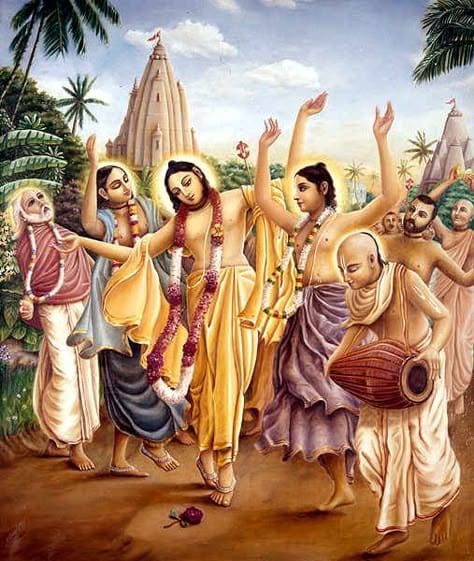
described in the Bhagavata. One of his social attitudes gets reflected where any kind of social ethnic intercourse with women was forbidden to his followers and Chaitanya himself refused to see the face of one of his most favourite disciples, for no greater offence than having exchanged a few formal words with an elderly Vaishnava Lady, whose piety and virtue were well known to him. He did not lay great stress on knowledge, though a profound philosophy grew around his teachings in the course of time. He lay down by his precept and example, sincere zeal and devotion and a passionate love for Hari or Krishna as the only means of salvation, and elevated the simple recitation of the names of Hari and Krishna to the level of high spiritual discipline as a “sacred mantra”. He emphasised universal love and brotherhood as the first step to the love of God – a profound social outlook indeed! He was a mystic par excellence and may even be said to have carried his mysticism beyond all rational limits. Yet though he did not care for rituals , he didn’t discard the sacred scriptures or worship of images of Gods, as utterly useless. ..
Another ‘social irigredient’ is noticed to prevail in his cathelic spirit that made no distinction between the Brahmanas, Chandalas, and Yavanas (Muslims) and brought them all within the fold of his religion of love and charity. This liberal outlook, which formed an essential feature of Chaitanya sect atleast to begin with, was one of the most important reasons for its wide popularity among the masses. .
Chaitanya did not leave behind any regular organisation to carry on his work, but as in the
flourishe.The main sect, wh d in Bengal, rapidly became very, popular and exists even today.
Kabir
Tradition holds that he was son of a Brahmin widow, who had abandoned the child to hide her shame. Niru, a local weaver noticed the newborn baby and as he had no. children of his own, both he and his wife gladly adopted him as their own son. This very Brahmin child, brought up by a Muslim. Later became a zealous advocate of Hindu – Muslim unity on the social and metaphysical planes – A great social awareness indeed! Kabir is taken to be a Saint of the Nirguna Pantha. That he was indebted to the Hindus for his views on ‘Brahma’ and ‘Maya’ is amply proved by the utterances attributed to him. But he has mixed up with it the hathyoga of Vajrayanis and Gorak Panthis. In imitation of the Yoga’s and Sadhus of those two sects he too has indulged in boastful assertions about his knowledge of the ultimate reality. He was indebted to the Sufis also from whom he learnt much of mysticism. From the teachings of his Guru Ramananda, he incorporated the elements of non-violence, morality, bhakti and prapti. Thus he fixed upon certain spiritual conception the basis of meditation over what he had heard from others and what he acquired by his own Sadhana and personal experience. This formed the crux of his teachings. His utterances have been grouped together as RamainisSakhis & Sabads and they are collectively called the Bijak.
The supreme reality according to Kabir is one although it has been called by different names such as Sahab, Allah, Rama, and Rahim and Brahma. Wisdom consists in getting at the basic unity underlying the multiplicity of names. The ultimate reality is formless and yet the master of this universe. His consort “Maya” has distracted everybody. A loving devotion to Him will bring deliverance from “Maya” by his grace. Thus by the fusion of the formless with the form a basis for Bhakti has been devised. The bhakti or devotion should be’ emotional and unalloyed. The repetition of His name should be an “internal” and “intermittent” affair. The search for the Divine should be conducted not outside but inside one’s ownself. Consequently worshipping a stone idol or shouting in the mosque is meaningless. What is needed is purity of emotion, fear of the Lord, moral conduct and an attitude to fraternal affection for all and not violence in the name of religion. In search for the Divine within oneself he recommends listening to the ‘nad’ or ‘music’ within. He has thus tried to bring out the fundamental unity of Islam and Hinduism. He dubs the Brahmins and the Mullahs as ignorant, credulous, vain and misguided and exhorts them to accept the truth. Another important aspect of his pure ‘social outlook’ says that he attaches no importance to caste and creed. He doesn’t even attach importance or merit to scriptural learning. His views are able to influence later generations too. But there is a short coming or draw back, as a majority of the ‘Kabir Panthas’ were from the uneducated people oflower castes, the Pantha has failed to secure that prestige which the coming of the higher castes would have given it.
Some poems of Kabir to show the purity of Bhakti towards God or the Supreme Reality of the Cosmos.
(a) “On my tongue Vishnu
In my eyes Narayan,
In my heart Gobind dwells,
My meditation is Hari”.
(b) “0 Servant where does / thou seek me
Lo, I am beside thee
I am neither in temple nor in mosque;
I am neither Kaaba or in Kailash?
Neither am I in rites and
Ceremonies, nor in Yoga and renunciation –
If thou art a true seeker,
thou shalt at once see Me,
thou shalt meet Me in
a moment of time
Kabir says, “0 Sadhu! God is the breath of all breath”.
Nanak
Just like Kabir, Nanak the founder of Sikhism also preached devotion of God without attributes and he initiated into his faith, people of all castes and creeds without any distinction whatsoever of Hindus and Muslims or high and low. But there is an essential difference between Kabir and Nanak. Though Nanak also uses Persian and Arabic expressions, it is the Hindu Shastras that form the basis of his doctrines and he refers to the current social evils in a far milder language. His temper is characterised by humility and not vanity. That is why his views have found equal acceptance at the hands of the high castes as well. The religion founded by Nanak checked conversion of the Punjab Hindus to the Muslim faith and later it led to the foundation of a strong and virile community which has won for itself a place of pride in the national history of India.
Again Nanak did not believe in the ‘Vedas’ and ‘Quran’. He was against the supremacy of the Brahmanas and the Mullahs, ritualism and formalities of religion. He believed in the ‘doctrine of Karma’ and the theory of ‘transmigration of souls’. In his teachings morality, humility, honesty, charity, truth and mercy had a prominent place. Almost repeating the nazae of Hari (God) and absolute obedience to the ‘Guru’ in body and mind were the main duties of the Sikhs. He wrote inspiring poems and songs, which were collected in a book form and later published as ‘Adi Grantha’.
Nanak laid emphasis on the oneness or unity of God. His concept of God was ‘Nirguna’ and ‘Nirankar’. The aim of man should be to merge in God. That could be done by complete surrender to Him and not by pilgrimage, idol worship, self-torture or mechanical recitation of his name. To him, ‘renunciation’ implied running away from the tumult and turmoil of life. He advocated a ‘middle path’ between extreme ‘asceticism’ and ‘free satisfaction of the senses’. Not being a professed social reformer, Nanak did not aim directly and specifically at the removal of social injustice. His primary purpose was to facilitate man’s progress in his spiritual journey. For such progress he did not consider social qualifications – high caste or rank in the social hierarchy to be at all necessary, a craving for spiritual bliss would be the only passport. This idea was itself social revolution and its ultimate results were likely to be the elimination of the caste system.
Nanak’s ethical teachings are relevant to an egalitarian society. He connects ‘honest labour’ with ‘spiritual progress’. To live on offerings for performance of religious ceremonies, as the Brahmins do, is to take poison. Truth is to be brought into close relation with practical life. To know the truth is not enough, it should be made a part of life. It is through acting in accordance with truth that one finds release. He advises to have continuous struggle against ‘five thieves’ – lust, anger, grew, attachment and egoism – as also sincere cultivation of virtues such as contentment, compassion, forgiveness, love, and selfless service etc. Thus his teachings are directed towards man’s well being in both heaven & earth.
The influence of Sufism on Nanak’s thought is intangible. It is hardly correct to say that he was manifestly steeped in Sufi love, for there is a conspicuous lack of Sufi terminology in his hymns. There are however interesting similarities in respect of some ideas and literary images. Nanak advises man to seek God in his own heart. The heart, according to the Sufis, is the seat of ‘Divine Grace’ and there the Lord is to be sought. Again, the relation between God and the devotee is compared in Nanak’s hymns as also in Sufi compositions to the relation between husband and wife. But the same idea is found in the devotional literature of the Vaishnavas. There is very little in common between the several stages of spiritual journey described in Nanak’s Tapji and those recognised by the Sufis.
Apart from other major saints of the Bhakti cult, Dadu Dayal from the ‘mochi’ class, Raidas of Varanasi,Mirabai from Chittor, Jnaneswar, Namdeva, Eknath, Tukaram- all from Maharashtra, Goakhnath in northern India it is to be remembered that no account of the exponents of ‘The Bhakti Movement’ can be complete without the brief description of the two great poets; Sur Das and TulsiDas who flourished in the later half of the 16th and the first quarter of the 17th century. Both were saints of a high order, but no preachers and reformers in the formal sense, and neither of them founded a sect. Both were, however, authors of several first-class works in Hindi, which are the highest compositions of the religion of love and devotion to a personal God and a source of inspiration to millions of men and women all over northern India for more than than 300 and odd years. Apart from Tulsi Das’ ‘Ramayana’, three of Sur’s works are very popular: they are ‘Sur Sarawali’, ‘Sahitya Ratna’ and ‘Sur Sagar’.It is said that ‘Sur Sagar’ contains one lac twenty five thousand verses.But it seems probable that the tradition of one lac verses is correct.The ‘Sur Sagar’ is not only saturated with love and devotion but is also notable for depicting Krishna as a child. The author has displayed a mastery of child psychology as one of a sincere devotee of the Almighty. Thus it can be claimed that both of them have produced a tremendous effect on humanity and zuided it to the oath of bhakti.
The impact of the Bhakti movement among the two important religious movements viz. Bhakti & Sufi on the contemporary society didn’t arrive at an immediate halt i.e. to say the stream of their thoughts and teachings continued to flow steadily through the later religious movements. As Bhakti and Sufi movements are indebted to Jainism and Buddhism, similarly the later movements owe a lot to the ideals and teachings upheld by Bhakti and Sufi Movements. In this connection we may state the example of the 19th century religious movement that didn’t limit itself to religion only but assumed an enormous proportion. In both Jainism and Buddhism the principal emphasis is laid upon the theme of non-violence. Jainism believes in the existence of soul in every being on the earth, no matter if it is animate or inanimate. According to them salvation or moksha means to get freedom of permanence from the cycles of birth and rebirth. This can only be attained through ‘Right Faith’, ‘Right Conduct’ & ‘Right Knowledge’ known as Triratna. Besides advising the complete abdication of ‘violence’, ‘falsehood’ & ‘luxury’, Lord Buddha’s main emphasis is on ‘renunciation’ and ‘knowledge’. His famous eight-fold is the only way to achieve ‘salvation’. Apart from the above ones.- one can truly focus on the ‘Ramakrishna & Vivekananda movement’ that added an extra dimension to the world of religion and philosophy.
However, it is to be noticed that the ideals set by the Bhakti and Sufi saints before our very eyes attained the fettle of a more matured form in the hands of Sri SriRamakrishna Paramhamsadeva who was the main preceptor of the famous 19th century ‘Ramkrishna – Vivekananda Movement’. The situation was morbid from a variety of angles at that point of time. But amid such a turbulent ambience it was ‘He’ who with his powerful instrument of ‘simple and lucid language’ sent the fragnant tidings of ‘sheer fraternity’ to the society. His eminent utterance ‘Joto mottoto poth’, was truly potent in every sense to awake the common people from their deep slumber. Moreover he opined suspicion, distrust, restlessness, greed, anger, hatred, jealousy can only be placed by the sweet fragnances of love and devotion for each other. His disciple Vivekananda echoed the same idea upheld by him. For him strength courage and self-confidence are the essence of religion, all others are peripheral. ‘Each soul is potentially divine’ – he used to say ‘Man is not just man, but also God, God only potentially now but with every chance that this potentiality shall some day be transformed into reality’. The goal of man is to grow till the divinity that is in man becomes manifest. Thus it is in fact the incisive reflection of ideals preached by the pioneers of ‘the Bhakti movement’.
Bibliography
Ahamad Shah, The Bijak of Kabir, Hamir pur, 1917.
Appasamy, A.J. , Temple Bells: Readings from Hindu Religious Literature, Calcutta 1930.
Banerjee, A.C. , Guru Nanak to Guru Govind Singh, New Delhi, 1978.
Banerje, A.C. , The State and Society in Northern India (1206-1526) Calcutta, 1982.
Banerjee, A.K. , Philosophy of Gorakhnath, Gorakhpur, 1961.
Benkey Behari, Sufis, Mystics and Yogis of India.
Barnett, L.D., The Heart of India, Wisdom of the East Series London, 1908.
Bhagi, M.L., Medieval Indian Culture and Thought, Ambala, 1965.
Bhandarkar, R.G. , Vishnavism, Saivism and Minor Religious Systems.
Carpenter, J.E. , Theism in Medieval India, London 1926.
De, S. K. , Early History of the Vaishnava Faith & Movement in Bengal Calcutta, 1942.
Deleury, G.A., The Cult of Vithoba, Poona, 1960.
Farquhar, J.N. , An Outline of the Religious Literature of India, London, 1920.
Geotz, H. , The Genesis of Indo-Muslim Civilization, Calcutta, 1938.
Grewal, J.S. , Guru Nanak in History.
Harbans Singh , Guru Nanak and Origin of the Sikh Faith.
Hussain, Yusuf , Glimpses of Medieval Indian Culture, Bombay, 1957.
Mujumdar, R.C. (Ed), The Delhi Sultanate, Bombay, 1980.
Nabi, M. N., Development of Muslim Religious Thought in India (1200-1405), Aligarh, 1962.
Nizami, K. A., Some Aspects of Religion and Politics in Indian During the 13th Century, Bombay, 1961.
50).
Nizami, K. A., Religion and Culture in India during the Thirteenth Century, Delhi, 1974.
Centuries, Agra, 1965.
Sen, Ksitimohan , Medieval Mysticism in India translated by M. Ghosh, London, 1936.
Srivastava, A.L., Medieval Indian Culture, Agra 1983.
Tara Chand, Influence of Islam on Indian Culture, Allahabad, 1956.
Zaehner, R.C., Hindu & Muslim Mysticism, London, 1960.
Dr Kunal Roy
( Assistant Professor, Department of English Language and Communication, George Group of Colleges, Kolkata)
.