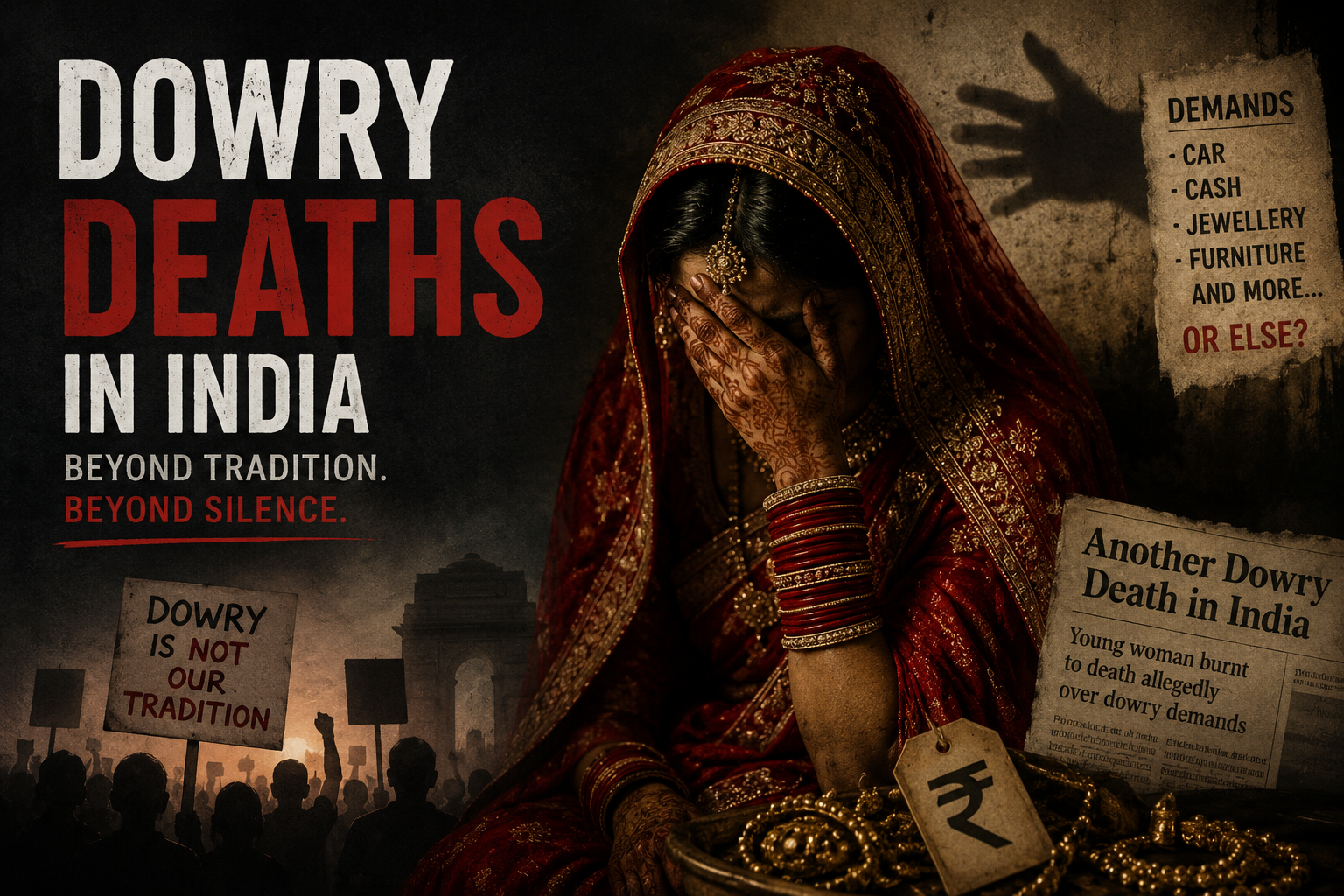
Dowry Deaths in India: When Marriage Becomes a Marketplace
–by Shivangi Mittal
In India, marriage is often described as a sacred institution, one that unites two families, celebrates love, and carries the weight of cultural traditions. Yet beneath this idealized image lies a darker reality that millions of families know all too well. In too many cases, marriage becomes entangled with financial expectations through the practice of dowry, turning what should be a union of equals into a commercial transaction with life-or-death consequences. Dowry deaths represent one of the most tragic outcomes of this system. Every year, thousands of women lose their lives due to harassment, abuse, or violence linked to dowry demands. These deaths are not isolated incidents or stories from a distant era. They happen in cities and villages, in educated and uneducated households alike and they reveal not only the persistence of an illegal practice but the depth of gender inequality that continues to shape Indian society.
Dowry traditionally referred to property, gifts, or money given by a bride’s family at the time of marriage. Historically, it was sometimes framed as a form of financial security for the bride, her share of parental wealth transferred at the point of marriage. Over time, that framing quietly collapsed. What began as a gift became a negotiation, and what began as a negotiation became a demand. Today, dowry demands routinely include cash, gold, vehicles, household appliances, or property. Research shows that dowry was paid in 95 percent of marriages in rural India between 1960 and 2008 during the entire period it was technically illegal under Indian law. Families feel compelled to meet these expectations not out of generosity, but out of social pressure and genuine fear of what happens if they don’t. The Hindu Succession Act of 1956, before its 2005 amendment, was biased toward male heirs in property inheritance. Even after daughters gained equal legal rights under the amended Act, the social reality has often seen a woman’s inherited share quietly transferred to her marital home as dowry reinforcing her financial dependence rather than alleviating it. When daughters are seen as financial liabilities and sons as economic assets, marriage stops being a partnership and starts being a wealth transfer mechanism.
Dowry Deaths: A Persistent Crisis
Dowry-related violence remains a serious issue in India despite decades of legal reforms. According to the National Crime Records Bureau (NCRB), 6,156 dowry deaths were recorded in 2023, which means nearly 20 women die every day due to dowry-related violence. The problem has persisted over time. Between 2017 and 2022, more than 35,000 dowry deaths were reported across the country, reflecting the continuing scale of the crisis.
Dowry deaths are also concentrated in certain regions. States such as Uttar Pradesh, Bihar, Madhya Pradesh, and Rajasthan together account for a large share of these cases. Even when cases are reported, conviction rates remain low, with only around 11–17% of cases resulting in conviction, highlighting challenges in investigation and prosecution. These figures show that despite strong legal provisions under the Dowry Prohibition Act, the IPC, and the Bharatiya Nyaya Sanhita (BNS), dowry-related violence continues to claim thousands of lives every year.
Legal framework
India has built a significant body of law to address dowry related violence over six decades. The Dowry Prohibition Act, 1961 was the first dedicated legislation on the issue it made giving, taking, or even demanding dowry a criminal offence. Stronger provisions followed under the Indian Penal Code: Section 304B specifically defined “dowry death” as the unnatural death of a woman within seven years of marriage where dowry-linked harassment is proven, carrying a minimum sentence of 7 years extendable to life. Section 498A, introduced in 1983, criminalized cruelty and harassment by a husband or his relatives including dowry related abuse. One important feature of Section 304B is that it flips the burden of proof: once harassment before death is established, the accused must prove their innocence, not the other way around a deliberate design choice for a crime that almost always happens behind closed doors. In 2024, India replaced the IPC with the Bharatiya Nyaya Sanhita (BNS), which carries these provisions forward under new section numbers (Section 80 for dowry death, Sections 85–86 for cruelty). The punishment stays the same, though one structural gap remains dowry deaths that occur after seven years of marriage still fall outside the strongest protections, leaving those families to rely on provisions that carry far lighter sentences
The Human Stories Behind the Numbers
Statistics cannot fully capture the human cost of dowry-related violence.
In 2010, Nisha Sharma, a young woman from Uttar Pradesh, called off her wedding when the groom’s family demanded additional dowry at the last moment. Her decision attracted national attention and sparked public debate about dowry expectations in marriage.
Although Sharma’s case did not end in tragedy, it highlighted the immense social pressure women face when confronting dowry demands. Many women lack the support or resources necessary to challenge such expectations.
Tragically, many cases end very differently. In 2012, Geetika Sharma, a young air hostess from Delhi, died by suicide after prolonged harassment and pressure linked to personal and professional exploitation. Her death drew widespread attention to how persistent harassment and power imbalances can push women toward extreme distress.
For thousands of women across the country, the pressure continues even after marriage, escalating into harassment, abuse, and sometimes fatal violence.
When Law Exist but Justice Doesn’t
The legal framework is established; however, the issue lies in the subsequent actions or inactions following the filing of a complaint.
According to the National Crime Records Bureau (NCRB), the conviction rate for dowry death cases in Indian courts ranges from 11% to 17%. Of the approximately 6,500 dowry death cases that proceed to trial annually, only about 4,500 of the estimated 7,000 cases are charge-sheeted, with over one-third failing to progress beyond the investigation stage. In Uttar Pradesh, which reported 2,200 dowry death cases in 2022, convictions were achieved in only 320 cases, reflecting a conviction rate of 14.5%. Similarly, Bihar recorded 110 convictions out of 1,000 cases. These figures are indicative of a broader trend across states where the issue is most pronounced.
Dowry harassment often leaves minimal physical evidence. Victims’ dying declarations, admissible under Section 32(1) of the Evidence Act, sometimes constitute the sole testimony available, yet courts have exhibited inconsistency in their treatment. Witnesses frequently become hostile, and trials can extend over several years, or even decades. Families often deplete their financial resources, energy, and confidence in the judicial process. Additionally, police reports are frequently incomplete, and there are instances where law enforcement actively discourages women from pursuing complaints, framing domestic violence as a private issue rather than a serious criminal offence.
The Problem of Underreporting
Official crime data does not capture the full extent of dowry-related violence. Researchers have pointed out that NCRB statistics follow the “principal offence rule,” meaning that when multiple crimes are recorded in a single case, only the most serious offence is counted. As a result, dowry-related motives may disappear from official records if the case is classified under another category. Social stigma also discourages reporting. Families may fear community backlash, damage to family reputation, or retaliation from the husband’s relatives. For many women experiencing dowry harassment, silence appears to be the safest option.
Addressing the Problem
Combating dowry deaths requires more than better laws though better enforcement of existing laws would already be a significant step forward. A meaningful response has to work across multiple levels simultaneously.
1 Strengthen Legal Enforcement: Police and judicial authorities need dedicated training to investigate dowry-related crimes effectively. Fast-track courts, time-bound investigation mandates, and witness protection mechanisms can help ensure that cases do not collapse before reaching a verdict.
2 Promote Public Awareness: Educational campaigns that directly challenge the social normalization of dowry can shift attitudes over time particularly when they reach young people before marriage becomes a consideration.
3 Empower Women Economically: Access to education, employment, and financial independence reduces a woman’s vulnerability and gives her real options when a marriage becomes dangerous. Economic dependence is one of the most effective traps keeping women in abusive households.
4 Engage Communities and Institutions: Religious leaders, educators, and community organizations have influence that the law simply does not reach. States like Kerala and Telangana have piloted public recognition for families who conduct dowry-free marriages shifting the social signal from acceptance to accountability.
5 Improve Data and Monitoring: NCRB data needs to be disaggregated capturing pending trials, conviction rates by state, case withdrawal rates, and offences that are currently subsumed under the principal offence rule. Accurate data is the foundation of effective policy.
Conclusion
Dowry deaths in India represent a tragic intersection of tradition, economic pressure, and deeply rooted gender inequality. When marriage becomes a marketplace governed by financial expectations, the dignity and safety of women are placed at risk and the consequences, as six decades of data make clear, are fatal for thousands of families every year.
India’s legal system from the Dowry Prohibition Act of 1961 to the provisions under the IPC and now the Bharatiya Nyaya Sanhita recognizes the gravity of dowry-related violence and has built real legal teeth into its response. But laws that go unenforced offer cold comfort to the families they were meant to protect. A conviction rate of one in six is not justice. It is a system that has learned to process tragedy without meaningfully reducing it.
Meaningful change requires something harder than legislation: a genuine shift in how society views marriage, daughters, and gender equality. Laws alone cannot dismantle a system sustained by social expectations and economic pressures. Only when dowry is rejected not just in statute books but also in wedding negotiations, community spaces, and family homes can marriage return to what it should have always been a partnership built on respect and equality, not a transaction built on debt.
–Shivangi Mittal